


Fruiting Body vs Mycelium: What the Terms Mean
A mushroom extract can be made from the fruiting body (the visible mushroom) or the mycelium (the fungal thread network, often grown on grain). The two are different parts of the same organism, they have different compositions, and they are measured in different ways. This guide explains those terms, along with dual extraction, the 10:1 ratio, and beta-glucans.
Fruiting body vs mycelium: what's the difference?
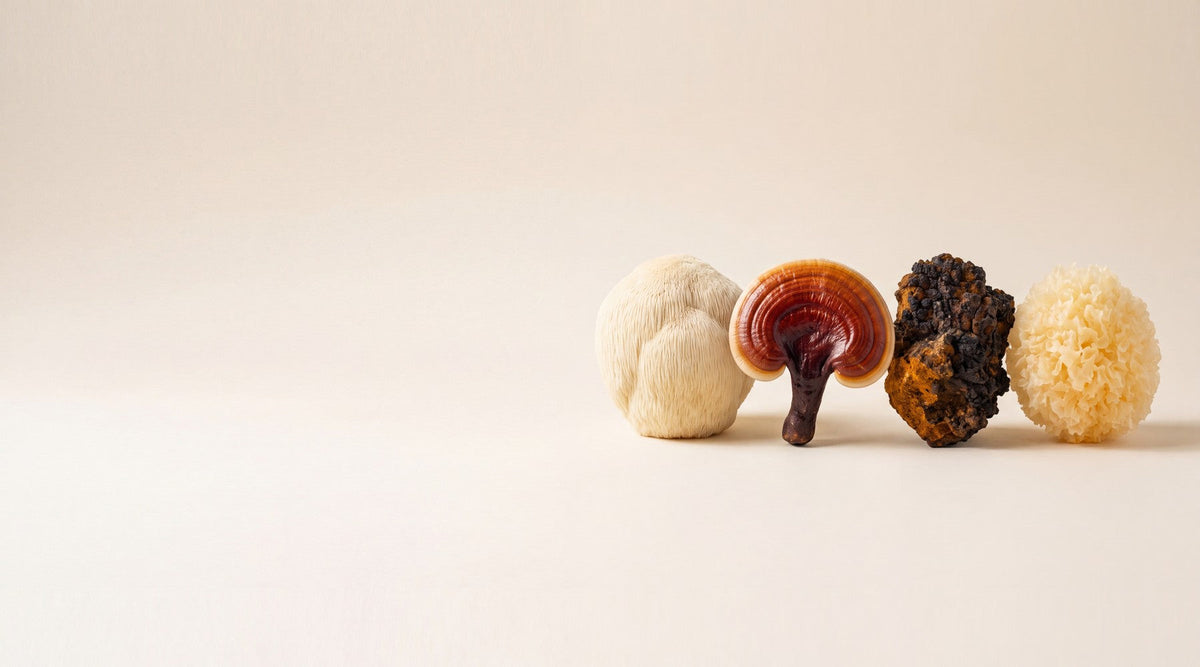
A fungus has two main parts. The mycelium is the underground network of fine threads that acts as the organism's root-like system. The fruiting body is the part most people picture as "the mushroom" — the reproductive structure that grows above the surface. Both are genuine parts of the fungus, but they are grown, harvested and analysed differently.
In commercial supplements, mycelium is usually cultivated indoors on a grain substrate (commonly rice or oats). Because the mycelium grows through and binds to that grain, the harvested material typically includes a portion of the grain itself. This is often labelled mycelium-on-grain or mycelialised grain. Fruiting-body products, by contrast, are made from the harvested mushrooms.
| Feature | Fruiting body | Mycelium-on-grain |
|---|---|---|
| Part of the fungus | The visible mushroom (reproductive structure) | The thread-like network, grown on grain |
| How it's grown | Cultivated or wild-harvested mushrooms | Cultivated indoors on a grain substrate |
| Residual grain / starch | None | Often present in the finished powder |
| Typical beta-glucan level | Higher, and easier to verify by testing | Lower, as the grain dilutes the fungal content |
Neither is inherently "fake," but they are not interchangeable. Independent analyses — including a 2020 study in the Journal of Fungi — have reported that fruiting bodies generally contain a higher proportion of beta-glucans than mycelium-on-grain material, largely because the grain substrate adds starch and dilutes the fungal fraction.
What are beta-glucans and polysaccharides?
Polysaccharides are large carbohydrate molecules made of many sugar units linked together. They are one of the most-discussed components of mushrooms, and much of the current scientific interest in fungi centres on this group of compounds. Importantly, "polysaccharides" is a broad category: starch from grain is also a polysaccharide.
Beta-glucans are a specific type of polysaccharide found in the cell walls of mushrooms. Because beta-glucans come from the fungus rather than from grain, they are frequently used as a marker of how much genuine mushroom material an extract contains.
What does "dual extraction" mean?
Different compounds in a mushroom dissolve in different solvents, so a single extraction method captures only part of what the fungus contains. Dual extraction (sometimes called double extraction) uses two stages to draw out a broader range of components:
- Hot-water extraction draws out water-soluble compounds, including beta-glucans and other polysaccharides.
- Alcohol extraction draws out compounds that don't dissolve well in water, such as triterpenes (a group of compounds particularly associated with mushrooms like reishi and chaga).
The two liquids are then combined and concentrated. A water-only extract will not carry the alcohol-soluble fraction, and an alcohol-only tincture will not carry the full water-soluble fraction — which is why dual extraction is often described as capturing a fuller spectrum of a mushroom's compounds. Not every mushroom is traditionally prepared this way, but for triterpene-rich species it is a common approach.
What does a 10:1 extract ratio mean?
An extract ratio such as 10:1 tells you how concentrated the extract is. A 10:1 ratio means that roughly ten kilograms of raw mushroom were used to produce one kilogram of finished extract. In practical terms, one gram of a 10:1 extract is derived from about ten grams of the starting mushroom.
A higher ratio indicates a more concentrated extract.
FAQ
What does 10:1 mean on a mushroom extract?
It's an extract ratio. A 10:1 extract uses about ten parts of raw mushroom to make one part of finished extract, so it is more concentrated than the raw material.
Why does dual extraction matter?
Some mushroom compounds dissolve in water and others in alcohol. Dual extraction uses both hot water and alcohol so the finished extract carries a broader range of the mushroom's water-soluble and alcohol-soluble components than a single-solvent method would.
What's the difference between polysaccharides and beta-glucans?
Beta-glucans are a specific type of polysaccharide found in fungal cell walls. "Polysaccharides" is a broader category that can also include starch from grain.
Food supplements should be part of a varied, balanced diet and a healthy lifestyle, not a substitute for one. If you are pregnant, breastfeeding or taking medication, talk to your doctor or pharmacist before use.

Leave a comment
This site is protected by hCaptcha and the hCaptcha Privacy Policy and Terms of Service apply.